
Differences Between the United States, the United Kingdom, and Italy

Although first aid guidelines are based on shared scientific principles—thanks to the coordination of international bodies such as the International Liaison Committee on Resuscitation (ILCOR)—notable differences exist between the United States and Europe, shaped by each region’s healthcare systems, cultural attitudes, and social structures. In Europe, the European Resuscitation Council (ERC) provides the core recommendations, which are then adapted at the national level by entities such as the Resuscitation Council UK and the Italian Resuscitation Council (IRC). In the United States, first aid protocols are developed primarily by the American Heart Association (AHA), in partnership with the American Red Cross and other medical institutions.
One of the most significant distinctions lies in the role and training of lay responders. In the United States, there is a strong emphasis on empowering individuals to take immediate and proactive action, supported by a legal and cultural framework that promotes personal responsibility. Public training initiatives like “Stop the Bleed” focus on managing life-threatening bleeding and using tourniquets—skills increasingly relevant due to the higher incidence of gun-related injuries in the U.S. context. In Europe, although public training is also a priority, there is typically greater emphasis on early activation of emergency services and on providing safe, basic assistance. In the United Kingdom, for example, communication with dispatchers and early use of an AED are emphasized, while in Italy, although following ERC guidelines, the approach often stresses scene safety and patient stabilization while awaiting professional responders, reflecting the different structure of the national emergency services.
Operational differences are most apparent in the management of severe bleeding and the priorities during cardiac arrest. In the
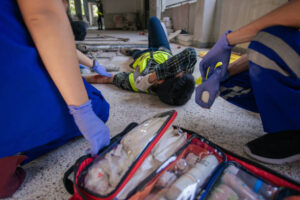
U.S., tourniquet use is widely accepted and promoted even among laypersons, whereas in the UK and Italy, direct pressure and the use of haemostatic dressings remain the standard, except in military or specialized settings. Regarding CPR, the compression-to-ventilation sequence and “Hands-Only CPR” are generally consistent across regions, but U.S. guidelines tend to recommend a faster, more autonomous response from bystanders, whereas European systems emphasize integration within the broader emergency response chain.
The variations between first aid guidelines in Europe and the United States do not reflect scientific disagreement, but rather local adaptations to differing public needs, trauma profiles, available resources, and healthcare infrastructures. While U.S. citizens are often trained and encouraged to manage high-risk scenarios such as gunshot wounds, European countries like the UK and Italy favor a more systemic and coordinated approach, where first aid is viewed as a critical first step within a structured emergency response network.
🌍 International
-
ILCOR (International Liaison Committee on Resuscitation)
https://www.ilcor.org
🇪🇺 Europe
-
European Resuscitation Council (ERC)
https://www.erc.edu -
Resuscitation Council UK (Regno Unito)
https://www.resus.org.uk -
Italian Resuscitation Council (IRC)
https://www.ircouncil.it
🇺🇸 United States of America
-
American Heart Association (AHA) – Guidelines
https://cpr.heart.org -
American Red Cross – First Aid & CPR
https://www.redcross.org -
Stop the Bleed – National campaign (trauma)
https://www.stopthebleed.org