
Portable Oxygen-Powered Ventilation Device for Early Resuscitation
The most innovative aspect is not the cylinder, but the patient interface.
A traditional mask requires:
- a good seal;
- two hands;
- training;
- continuous monitoring of its position.
For a single rescuer performing compressions and using an AED, this can be difficult.
Proposed Airway Interface
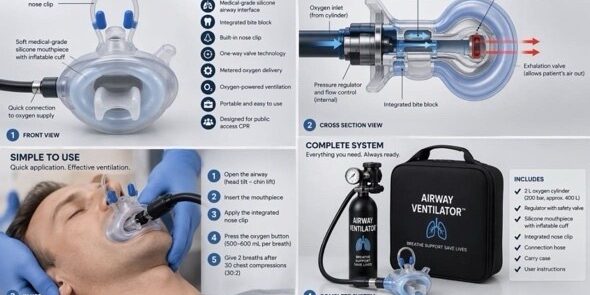
Instead of a standard CPR face mask, the CPR Airway Ventilator would use a soft medical-grade silicone oral interface inspired by scuba diving regulators.
The mouthpiece would be slightly larger than a standard diving regulator and specifically designed for emergency airway management.
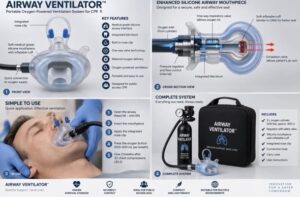
Key features would include:
- Soft medical-grade silicone construction.
- Anatomically shaped oral flange.
 Integrated bite block.
- High-flow oxygen inlet.
- One-way exhalation valve.
- Built-in nose clip.
- Quick insertion during resuscitation.
- Compatibility with both adult and adolescent patients.
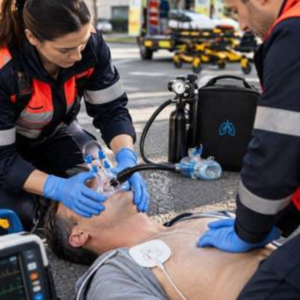
The rescuer would simply:
- Open the airway using the head-tilt chin-lift technique.
- Insert the silicone mouthpiece into the patient’s mouth.
- Apply the integrated nose clip.
- Press the delivery button twice.
- Resume chest compressions immediately.
Unlike conventional mouth-to-mouth ventilation, the device creates a controlled and hygienic airway connection while delivering oxygen-rich ventilation directly into the patient’s lungs.
How the Device Works
The system consists of:
Oxygen Cylinder
- 2 L medical oxygen cylinder
- 200 bar operating pressure
- Approximately 400 L oxygen capacity
Smart Pressure Regulation System
A built-in pressure reducer lowers cylinder pressure to safe ventilation levels.
Functions include:
- Flow regulation
- Overpressure protection
- Anti-barotrauma protection
- Automatic safety venting
Metered Ventilation Delivery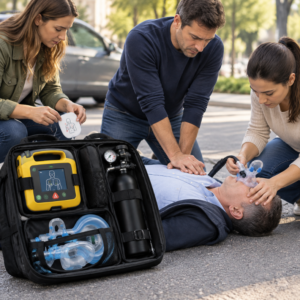
Each activation of the delivery button releases a predetermined tidal volume.
Proposed settings:
- Adult mode: 500-600 mL
- Small adult/adolescent mode: 350-450 mL
This would reduce the risk of:
- gastric inflation;
- regurgitation;
- aspiration;
- lung overinflation.
One-Way Valve System
The patient exhales through dedicated exhaust ports while fresh oxygen remains available for the next ventilation cycle.
Potential Advantages
Compared with Mouth-to-Mouth
- No direct contact.
- Improved infection control.
- Higher oxygen concentration.
- More consistent ventilation volumes.
Compared with a Bag Valve Mask (BVM)
- Smaller and lighter.
- Easier for a single rescuer.
- Faster deployment.
- No need for extensive training.
- Reduced risk of ineffective mask seal.
Compared with Existing Public Access CPR Resources
Current public-access cardiac arrest kits usually contain:
- AED
- Rescue mask
The proposed system would provide:
- AED
- Ventilation device
- Oxygen source
within a single emergency response package.
Potential Locations
The CPR Airway Ventilator could be installed alongside AEDs in:
- Airports
- Railway stations
- Shopping centres
- Sports stadiums
- Schools
- Universities
- Hotels
- Police vehicles
- Fire stations
- Industrial facilities
- Community first responder schemes
Mission Statement
 CPR Airway Ventilator™
“Making life-saving ventilation as accessible as defibrillation.”
The CPR Airway Ventilator is a concept for a new generation of public-access resuscitation devices, combining oxygen delivery, airway management, and controlled ventilation into a compact portable system that could help bridge the gap between basic bystander CPR and professional advanced life support.
The concept has now evolved into a portable oxygen-powered ventilator rather than a simple CPR mask. The most innovative aspect is the airway interface itself. Instead of relying on a traditional CPR face mask, the system uses a specially designed silicone mouthpiece that combines features of a scuba regulator, a supraglottic airway device, and a portable resuscitation ventilator.
Key Design Improvements
The next-generation design would incorporate:
- A soft medical-grade silicone mouthpiece.
- An enlarged oral section that is slightly larger than a standard scuba regulator.
- Intraoral insertion of approximately 3-4 cm to create a more stable seal.
- An integrated bite block to maintain airway patency.
- Built-in inspiratory and expiratory one-way valves.
- An integrated nose clip.
- A soft inflatable perioral cuff that seals around the lips and minimizes air leakage.
- Quick connection to the oxygen cylinder.
How It Works
The rescuer performs the head-tilt/chin-lift manoeuvre and inserts the mouthpiece into the patient’s mouth.
The integrated nose clip is applied automatically or manually to prevent air escape through the nostrils.
When the delivery button is pressed, the device releases a controlled volume of oxygen, approximately 500-600 mL, simulating an effective rescue breath while maintaining safe pressure limits.
After two ventilations, the rescuer immediately resumes chest compressions according to current CPR guidelines.
Advantages
Compared with conventional mouth-to-mouth ventilation, the device offers:
- No direct contact with the patient.
- Reduced infection risk.
- Higher oxygen concentration delivery.
- More consistent ventilation volumes.
- Faster deployment.
- Easier use for lay rescuers.
Compared with a bag-valve-mask (BVM), the device offers:
- Smaller size.
- Lower weight.
- Simpler operation.
- Reduced training requirements.
- Improved single-rescuer usability.
Vision
The long-term goal is to create for ventilation what the AED did for defibrillation:
A simple, portable, oxygen-powered device that allows almost anyone to provide effective ventilations during cardiac arrest.
Proposed Product Name: OxyFlow CPR
Portable Oxygen-Powered Ventilation System for CPR
Tagline: “Making life-saving ventilation as accessible as defibrillation.”
By an idea of : Manuel Carta