
Preserving the truth. Capturing every detail. Transforming forensic investigations.
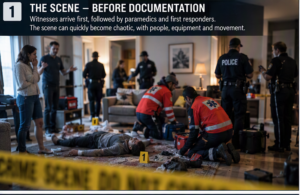
In modern forensic investigations, one of the greatest challenges is preserving a crime scene exactly as it appeared when first responders arrived. Every movement, every object displaced, and every environmental change can potentially alter crucial evidence. Traditional photography and manual measurements have long been essential tools, but advancements in digital technology are now redefining how investigators document and analyse crime scenes.
CrimeSphere is an innovative forensic documentation system designed to create a complete, immersive, and scientifically accurate digital record of a scene using advanced 360-degree imaging, ultraviolet scanning, thermal imaging, and 3D mapping technologies.
Why Traditional Scene Documentation Has Limitations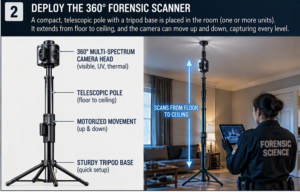
Crime scenes are often dynamic and highly complex environments. Witnesses, emergency medical personnel, police officers, and forensic teams may all enter the location before full documentation is completed.
Even with extensive photography and note-taking, important contextual details can be lost or overlooked. Investigators frequently face challenges such as:
- Changes caused by emergency interventions.
- Limited visibility of hidden biological traces.
- Time-consuming manual measurements.
- Difficulty reconstructing the original layout months or years later.
- Challenges in clearly presenting evidence to courts and juries.
These limitations highlight the growing need for a more comprehensive and objective method of documentation.
Introducing CrimeSphere
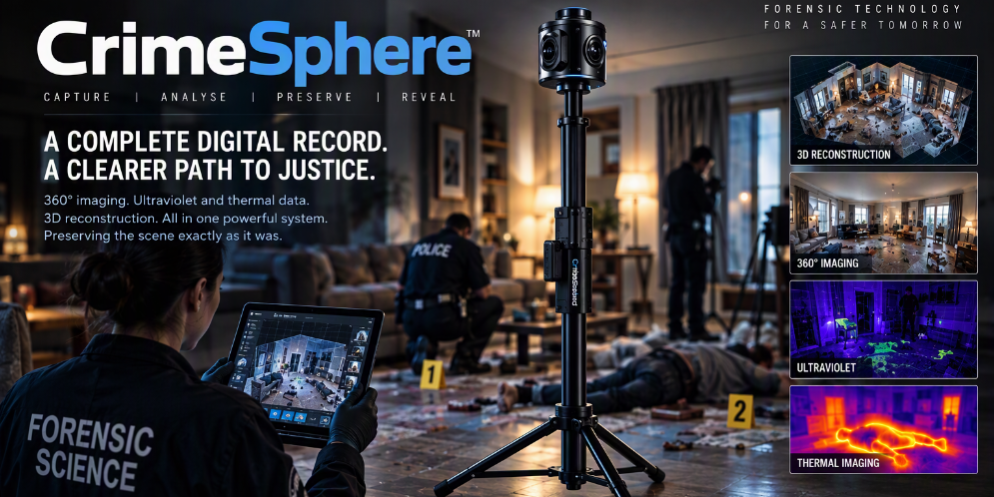
CrimeSphere is built around a compact telescopic scanning unit equipped with a sophisticated 360-degree multi-spectrum camera system. The device can be rapidly deployed within minutes and positioned anywhere within a scene.
Mounted on a stable tripod base, the scanner extends from floor to ceiling while automatically capturing information at multiple heights, ensuring that no critical area is missed.
The system records several data layers simultaneously, producing a highly detailed digital twin of the environment.
Key Features
360-Degree Ultra-HD Imaging
CrimeSphere captures high-resolution panoramic imagery of the entire scene, allowing investigators to revisit the location virtually at any time.
Ultraviolet Detection
UV imaging can reveal traces that may remain invisible under normal lighting conditions, assisting investigators in identifying potential forensic evidence.
Thermal Mapping
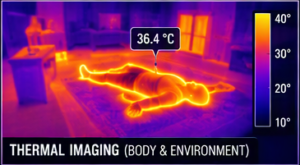
Integrated thermal sensors record surface and environmental temperatures, helping investigators visualise heat signatures and identify temperature anomalies at the time of documentation.
Advanced 3D Reconstruction
The system automatically generates a fully navigable three-dimensional model, providing an accurate spatial representation of the scene.
Creating a Complete Digital Record
The real power of CrimeSphere lies in its ability to merge multiple forensic datasets into a single integrated platform.
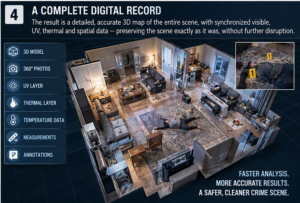
The final digital model can include:
- 3D scene reconstruction
- 360-degree photographs
- Ultraviolet imaging layers
- Thermal imaging layers
- Temperature measurements
- Dimensional measurements
- Investigator annotations
Rather than relying solely on static photographs, investigators gain access to a comprehensive digital environment that can be examined repeatedly without returning to the physical location.
Benefits for Investigators
Increased Accuracy
Digital measurements and spatial mapping help reduce documentation errors while providing a more precise record of evidence locations.
Faster Scene Processing
Rapid deployment and automated scanning can significantly reduce the time required to document complex scenes.
Improved Evidence Preservation
Once captured, the digital scene can be analysed repeatedly without any risk of contaminating or disturbing physical evidence.
Enhanced Collaboration
Investigators, forensic scientists, pathologists, prosecutors, and expert witnesses can review the same digital model regardless of location.
Stronger Courtroom Presentation
Interactive 3D reconstructions provide judges and juries with a more intuitive understanding of the scene than traditional photographs alone.
Beyond Criminal Investigations
While CrimeSphere is designed with forensic science in mind, the technology also has potential applications in:
- Fire investigations
- Road traffic collision reconstruction
- Industrial accident analysis
- Disaster victim identification
- Terrorism incident response
- Search and rescue documentation
- Occupational health and safety investigations
Any environment requiring meticulous evidence preservation and spatial analysis could benefit from this approach.
A New Era in Forensic Science
As forensic investigations become increasingly digital, systems such as CrimeSphere represent the next evolution of crime scene documentation. By combining ultra-high-definition imagery, thermal analysis, ultraviolet detection, and advanced 3D reconstruction into a single platform, investigators can preserve scenes with an unprecedented level of detail and accuracy.
The goal is simple: capture the truth exactly as it exists, preserve it indefinitely, and provide investigators with the tools they need to uncover critical evidence while maintaining the highest standards of scientific integrity.
CrimeSphere is not just a scanner. It is a complete digital forensic ecosystem designed to bring crime scene investigation into the future.