
When the Hospital Bed Becomes a Lifeline
Hospital evacuations are among the most complex challenges faced by healthcare organisations. Whether caused by fire, flooding, severe weather, infrastructure failure, power outages, chemical incidents, or other major emergencies, the safe movement of patients requires far more than simply transporting a person from one location to another.
During an evacuation, healthcare professionals must simultaneously manage the patient, life-support equipment, medications, clinical records, and ongoing treatments. In many cases, these critical elements are stored separately throughout the ward, creating additional risks during time-sensitive emergency operations.
This led me to explore a concept: What if the hospital bed itself became a self-contained clinical evacuation platform?
Introducing the Smart Evacuation Bed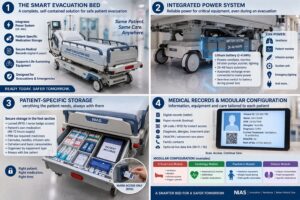
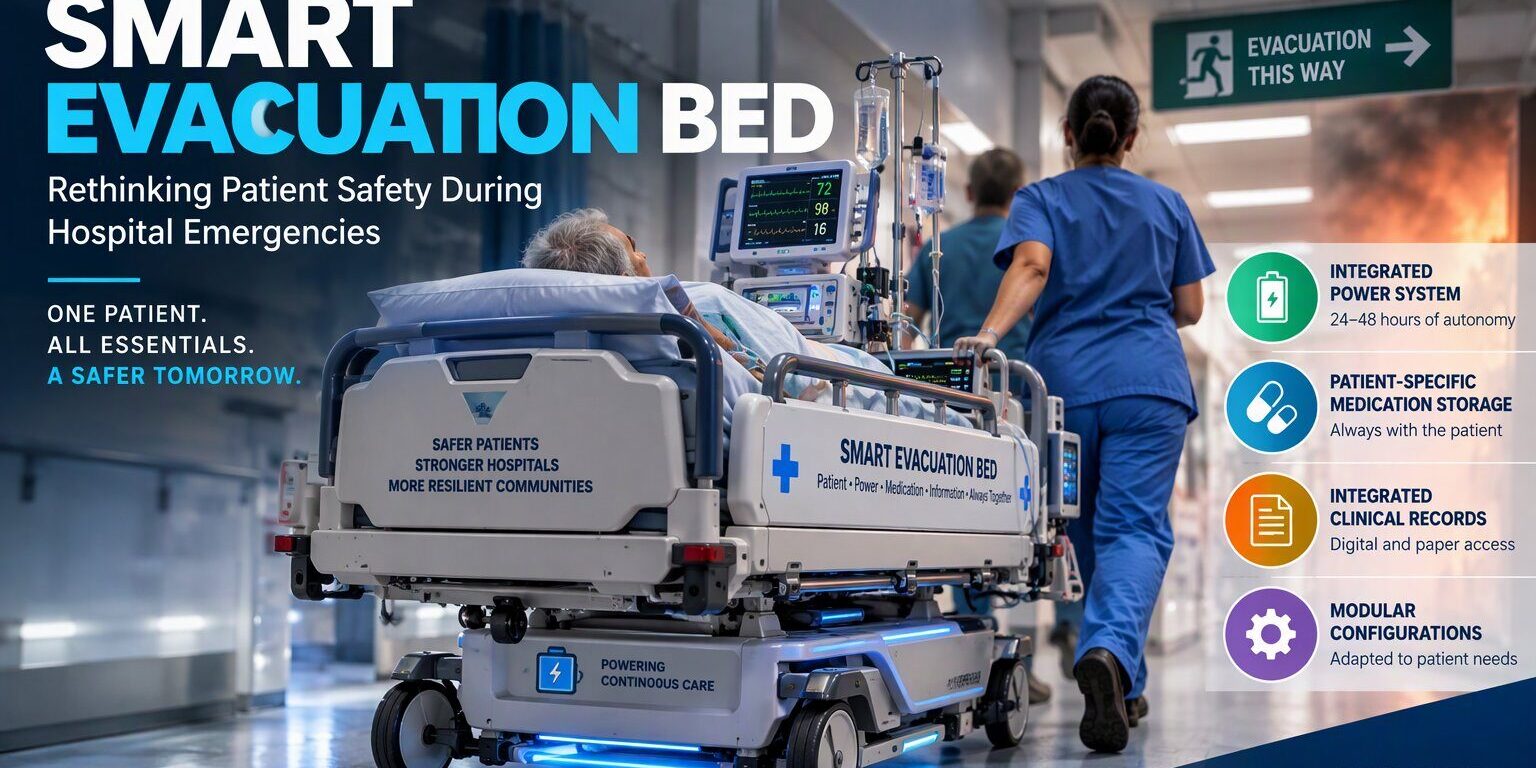
The Smart Evacuation Bed is a conceptual design aimed at improving continuity of care during hospital evacuations and emergency relocations.
Rather than functioning solely as a patient transport device, the bed would act as a mobile, self-sufficient clinical environment, ensuring that patients remain connected to the equipment, medications, and information they need throughout an emergency.
The guiding principle is simple:
The patient should never be separated from the essential resources required for their ongoing care.
1. Integrated Emergency Power System
One of the greatest challenges during evacuations is maintaining power to critical medical equipment.
The Smart Evacuation Bed would incorporate a high-capacity lithium battery system integrated within the lower chassis of the bed.
Potential capabilities could include:
- 24-48 hours of autonomous operation
- Automatic charging while connected to the hospital electrical system
- Seamless transition to battery power during outages
- Power supply for:
- Ventilators
- Patient monitors
- Infusion pumps
- Suction devices
- Emergency lighting
In effect, the bed becomes a mobile power station capable of supporting critical care during patient movement and temporary relocation.
2. Patient-Specific Medication Storage
In many hospitals, medications are stored centrally within treatment rooms, medication trolleys, or ward storage areas. 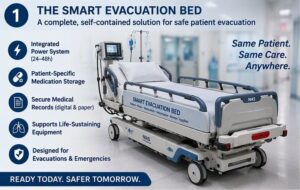
During an emergency evacuation, retrieving and transporting these medications can add complexity and increase the risk of delays or errors.
The Smart Evacuation Bed could feature a secure compartment located within the foot section of the bed, containing:
- The patient’s regular medications
- “As required” (PRN) medications
- Cannulas and IV equipment
- Basic dressings
- Essential clinical consumables
Access would be controlled through RFID, smart cards, or staff identification badges.
This would allow patients to be evacuated together with a supply of treatment sufficient for the immediate operational period, potentially 48-72 hours.
3. Integrated Clinical Information
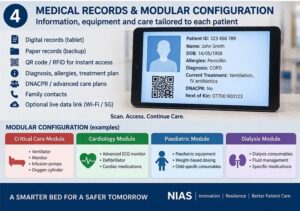
Maintaining access to clinical records during emergencies is crucial.
The Smart Evacuation Bed could include both:
Digital Records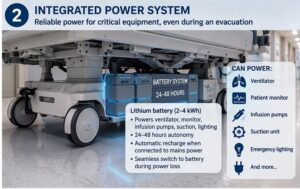
Accessible through:
- QR codes
- RFID technology
- Secure hospital networks
- Dedicated tablets mounted to the bed
Providing immediate access to:
- Medical history
- Allergies
- Medication charts
- Treatment plans
- DNACPR status
- Family contact information
Physical Backup Records
A protected compartment would also contain hard-copy documentation in case of network failures or IT disruptions.
This provides resilience through both digital and non-digital solutions.
4. Modular Clinical Configurations
Not all patients have the same requirements.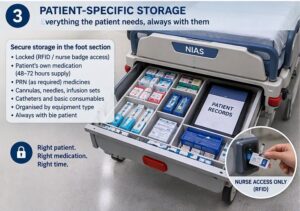
The Smart Evacuation Bed could be configured according to specialty-specific clinical needs.
Critical Care Configuration
- Ventilator
- Monitoring equipment
- Oxygen supply
- Multiple infusion pumps
Cardiology Configuration
- Advanced ECG monitoring
- Dedicated defibrillator storage
- Cardiac emergency medications
Paediatric Configuration
- Paediatric equipment
- Weight-based medication references
- Child-specific consumables
Dialysis Configuration
- Dialysis consumables
- Fluid management equipment
- Specialised medications
This modular approach would allow healthcare facilities to tailor beds according to patient dependency levels and clinical requirements.
Potential Applications
The concept could have relevance for:
- Hospital fire evacuations
- Flooding incidents
- Major power failures
- Infectious disease outbreaks
- Critical care transfers
- Emergency Preparedness, Resilience and Response (EPRR) planning
- Temporary field hospitals
- Mass casualty incidents
Looking to the Future
Future developments could include:
- Indoor GPS and location tracking
- Integration with hospital command-and-control systems
- Real-time vital sign transmission
- 5G connectivity
- Asset tracking
- Artificial intelligence-assisted monitoring
- Automatic patient identification and destination management
The ultimate goal would be to create a system that supports both frontline clinicians and emergency planners during some of the most challenging situations healthcare organisations may face.
Conclusion
The Smart Evacuation Bed is currently a conceptual idea, but it addresses a real operational challenge:
How do we maintain continuity of care when everything around the patient is changing rapidly?
By combining emergency power, medication storage, clinical records, and modular medical equipment into a single platform, it may be possible to improve patient safety, operational resilience, and emergency preparedness.
As hospital infrastructure continues to evolve, perhaps the hospital bed itself can become a key component of future evacuation and disaster response strategies.
a {
text-decoration: none;
color: #464feb;
}
tr th, tr td {
border: 1px solid #e6e6e6;
}
tr th {
background-color: #f5f5f5;
}