

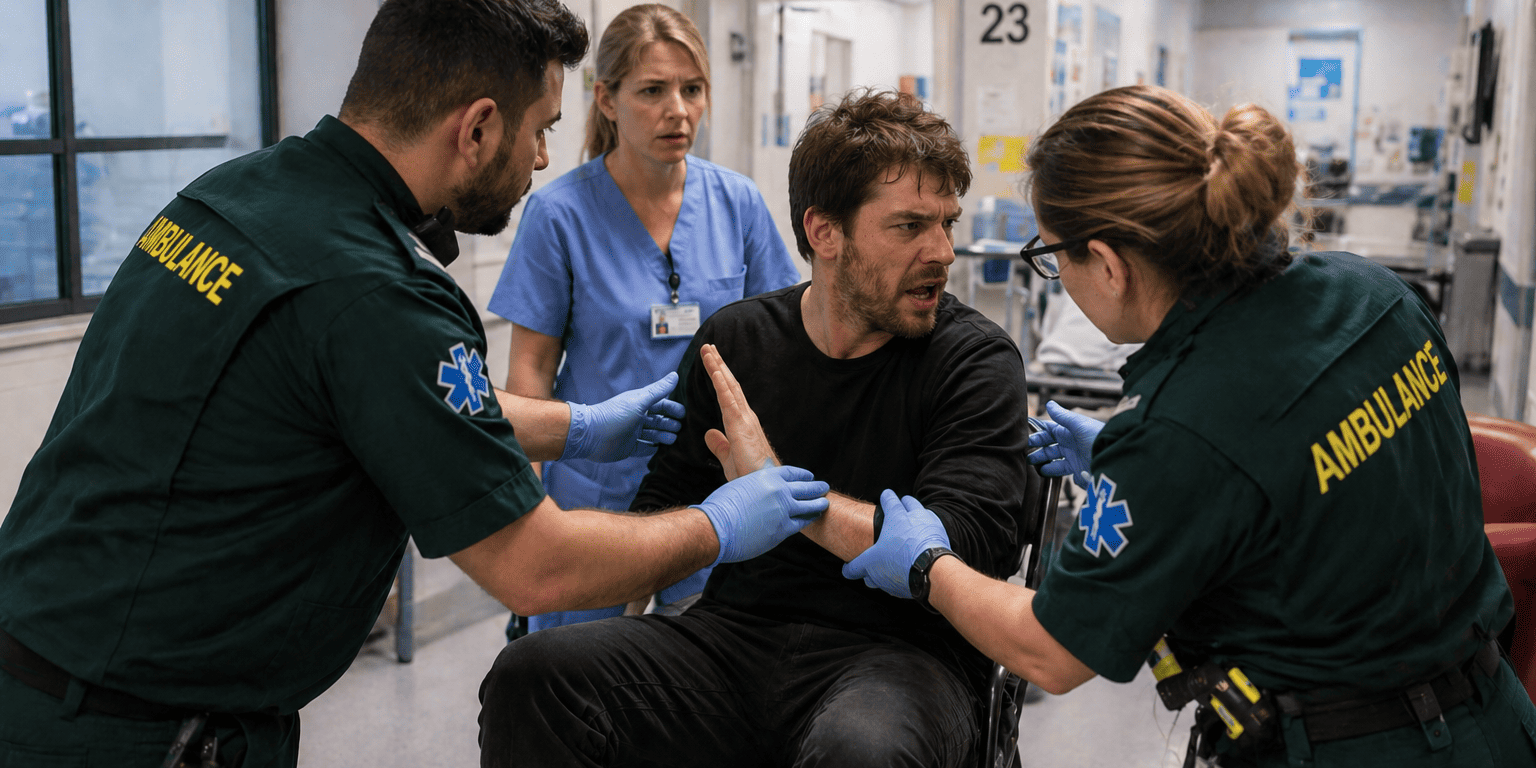
Operational approaches to safety, de-escalation, and decision-making in high-risk situations
Anyone working in emergency care knows that not all patients are the same, and not all situations can be approached with the same tools. Among the most complex—and often the most unpredictable—are encounters with patients in acute psychiatric crisis, particularly when agitation is accompanied by aggression or self-harm intent.
It is necessary to begin with a premise that may feel uncomfortable but is essential: in certain situations, it is not possible to engage with the patient as one would in a conventional clinical context. Communication based on rational dialogue, active listening, and negotiation can lose effectiveness when the patient’s perception of reality is significantly altered. This does not mean abandoning communication, but rather recognising its limits and adapting the approach accordingly.
In these scenarios, the first real intervention is not clinical but situational. The reading of the environment—distance, exit routes, the presence of potentially dangerous objects—becomes as important as any clinical assessment. This shift in perspective is not always explicitly addressed in training, yet in practice it often determines whether a situation remains manageable or rapidly escalates.
At the same time, communication takes on a different role. The objective is no longer to explain or persuade, but to contain. Tone of voice, body posture, and the ability to avoid direct confrontation become operational tools in their own right. In many cases, attempts to bring the patient back to a shared logic may be perceived as threatening or dismissive, with the unintended effect of increasing agitation rather than reducing it.
There are situations, however, where the window for dialogue narrows significantly. When imminent self-harm or dangerous behaviour emerges, priorities inevitably shift toward safety. In these moments, the responder operates within a delicate balance, where each decision must consider both the protection of the patient and the safety of the team. There is rarely an ideal solution, and actions are often taken within the constraints of what represents the least possible risk.
Aggression, when present, should not be interpreted solely as opposition or hostility. It is often an expression of fear, disorientation, or loss of control. This does not make it less dangerous, but it does require an approach that is not purely reactive. At the same time, it is essential to recognise that the safety of responders is non-negotiable. Teamwork, support from additional services, and early recognition of escalation signals are critical in preventing situations from deteriorating.
More than in many other types of emergencies, these cases highlight the limits of individual action. Effective management depends on coordination, integration, and an awareness that not everything can be resolved immediately. In this context, emergency response is not merely a technical act, but a complex process shaped by environment, behaviour, and operational response.
Addressing acute psychiatric crisis in emergency care does not mean searching for simple solutions to complex problems. It means acknowledging the need for a different, more realistic and adaptive approach—one that complements clinical expertise with situational awareness, and recognises that, in certain circumstances, managing the situation is first and foremost about containing risk, ensuring safety, and gaining time.
By Manuel Carta
#manuelcarta #emergencymanagement #managingthecrisis #nhs #rescueteam #paramedic #emt #aca #ambulanceservice