
From Idea to Prevention: Could a Simple Toy Help Reduce Choking Risks in Young Children? By Manuel Carta
Every parent knows the instinctive concern that arises when a baby or toddler puts an object into their mouth. Exploring the world through touch and taste is a normal part of childhood development, yet it is also one of the reasons why choking remains a significant cause of injury in young children.
As a first aid instructor, I have spent years teaching families how to respond to emergencies. However, an important question continued to emerge:
What if we could prevent more choking incidents before they happen?
This question inspired the concept of a simple, portable, child-friendly tool designed to help parents quickly identify potential choking hazards in everyday life.
Understanding the Risk
Every year, thousands of children experience choking incidents caused by food, toy parts, coins, batteries, and other small objects. Toddlers are particularly vulnerable because they explore their environment by placing objects in their mouths and have not yet fully developed the ability to chew and swallow safely.
For parents, one of the most difficult challenges is determining whether an object is too small and therefore represents a potential choking hazard.
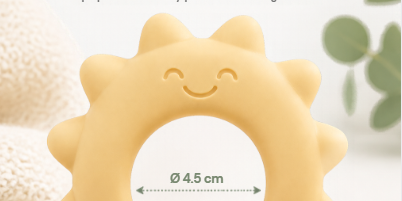
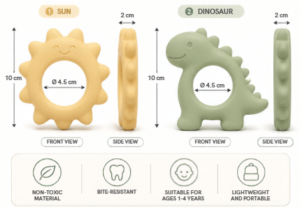
This project is based on a simple preventive principle: if an object can pass through a reference opening measuring approximately 4.5 cm in diameter, it should be carefully assessed before being given to a young child.
The goal is not to replace established safety standards, age recommendations, or parental supervision. Instead, it provides families with a practical, portable tool that encourages awareness and helps identify potentially hazardous objects before an accident occurs.
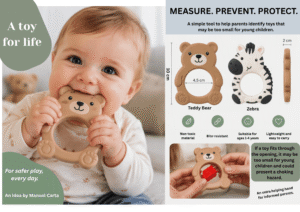
By transforming this safety concept into a child-friendly toy that can be attached to a stroller, changing bag, or carried in a pocket, parents gain an immediate visual method to assess toys, food pieces, and everyday objects while on the move.
In essence, the device acts as a simple reminder of an important message:
If it fits, think twice.
Because prevention remains the most effective strategy against choking.
A New Concept: A Toy That Measures Safety
The idea is simple.
Imagine a small, attractive toy shaped like a teddy bear, zebra, or other friendly animal. The centre contains a carefully designed opening based on recognised safety principles.
The toy could be attached to:
- A stroller
- A changing bag
- A car seat
- A keyring
- A backpack
Whenever a parent encounters an unfamiliar toy, food item, or object, they can perform a quick visual assessment.
If the object fits completely through the opening, it may be too small for a young child and could represent a choking hazard.
The concept transforms a professional safety tool into something practical, accessible, and easy to carry.
More Than a Toy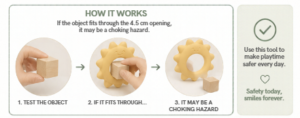
The vision goes beyond measurement.
Children naturally enjoy holding, touching, and chewing objects during early development. For this reason, the product could also be designed as a teething toy, manufactured from food-grade materials that meet strict European safety requirements.
Potential materials may include:
- Food-grade silicone
- BPA-free certified polymers
- Materials compliant with European toy safety regulations
- Materials tested for chemical safety and migration limits under EU legislation
Any future commercial version would need to comply with applicable standards and certification requirements, including those associated with the European Toy Safety Directive (2009/48/EC) and CE marking requirements.
[eur-lex.europa.eu], [compliancegate.com]
Educating Parents Through Everyday Use
One of the most powerful aspects of this concept is its educational value.
Many parents are unaware that:
- Small decorative parts can detach from toys.
- Older siblings’ toys may contain components that are unsafe for babies.
- Certain foods can present significant choking risks.
- Safety warnings on packaging are often overlooked.
A measuring toy creates an opportunity for continuous awareness.
Every time it is used, it reinforces an important safety message:
Measure. Prevent. Protect.
Rather than waiting until a choking emergency occurs, parents gain a simple method of assessing potential risks before handing an object to a child.
Bridging Prevention and First Aid
As healthcare professionals and educators, we often focus on emergency response.
Cardiopulmonary resuscitation (CPR), choking intervention, and first aid training are essential skills that save lives.
Yet prevention remains the most effective intervention of all.
A child who never encounters a choking hazard never requires emergency treatment.
This project aims to bridge the gap between professional safety standards and everyday parenting, making preventive assessment easier, more accessible, and more engaging.
Looking Ahead
The concept remains an innovative idea, but it reflects an important principle:
Safety tools should not be confined to laboratories and manufacturing facilities. They should be available wherever children live, play, and grow.
A simple measuring toy made from safe, child-friendly materials could empower parents with immediate, practical information and contribute to a reduction in preventable choking incidents.
Sometimes, the simplest ideas can have the greatest impact.
Measure. Prevent. Protect.
Because every child deserves a safer start in life.