
A New Vision for Prehospital Emergency Care –
By Manuel Carta
For decades, communication between ambulance crews and Emergency Medical Service (EMS) control centres has relied primarily on radio and telephone transmissions. While this approach has proven effective, it inevitably places significant responsibility on frontline clinicians to accurately describe complex and rapidly evolving situations using only verbal communication.
Modern healthcare systems increasingly depend on real-time information, yet in many EMS organisations critical operational and clinical decisions are still made based solely on what can be reported by voice.
This raises an important question:
What if the control room could see what the crew sees?
The Concept
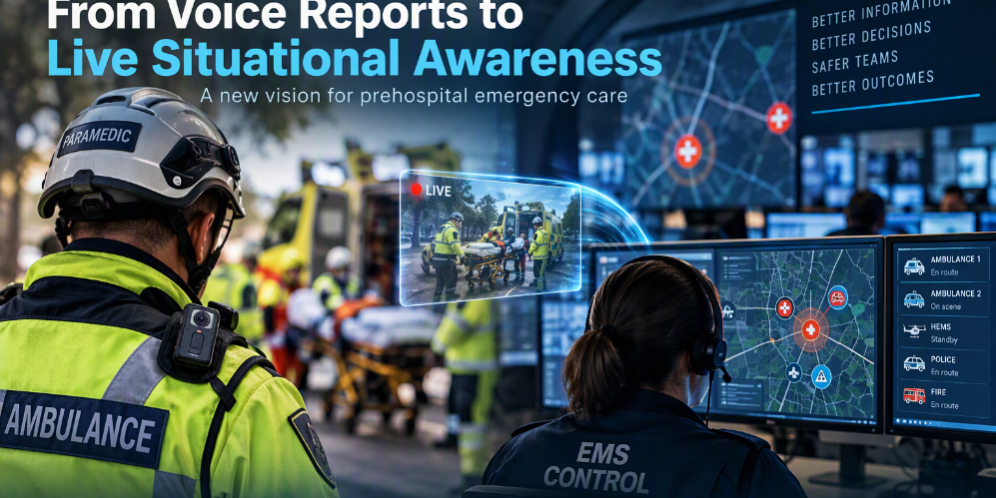
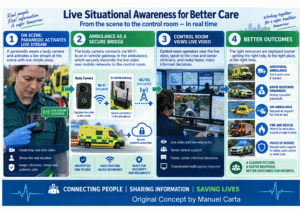
The proposal is based on a simple but potentially transformative idea: introducing live situational awareness through secure body-worn video technology integrated into existing ambulance communication systems.
Under this model, a clinician attending an emergency incident could activate a live video stream when additional operational or clinical support is required. The video would be transmitted securely through the ambulance’s communication infrastructure and mobile network to the Emergency Operations Centre.
Rather than relying exclusively on verbal updates, dispatchers, duty officers and senior clinicians would have access to real-time visual information from the scene.
The objective is not surveillance or routine recording of clinical activity. The purpose is to enhance situational awareness and support informed decision-making during complex incidents.
Why Current Communication Has Limitations
Even experienced clinicians can face challenges when attempting to describe a scene in detail while simultaneously assessing a patient, managing risks and coordinating treatment.
Control room personnel frequently need to make decisions regarding:
- Additional ambulance deployment
- Critical care response
- Helicopter emergency medical services (HEMS)
- Police assistance
- Fire and Rescue Service support
- Major incident escalation
These decisions are often made using incomplete or evolving information.
A live visual feed could provide a more accurate understanding of:
- Scene complexity
- Number of casualties
- Environmental hazards
- Mechanisms of injury
- Patient condition
- Resource requirements
allowing decisions to be made with greater confidence and potentially at an earlier stage.
Potential Clinical Benefits
One of the most valuable aspects of real-time video integration is the opportunity to strengthen the link between frontline clinicians and senior clinical support.
Visual access to the scene may assist specialists in understanding the context of patient presentations and contribute to more informed advice during high-acuity incidents.
Potential applications include:
- Major trauma
- Paediatric emergencies
- Cardiac arrest management
- Stroke assessment
- Entrapment and extrication incidents
- Multi-casualty events
In situations where seconds matter, reducing the communication gap between the scene and clinical decision-makers may contribute to improved patient outcomes.
Enhancing Responder Safety
Responder safety remains a growing concern internationally.
Ambulance personnel increasingly encounter violence, aggression, hazardous environments and unpredictable operational conditions.
A control room with live situational awareness may identify developing risks before they are fully communicated by crews on scene. Earlier recognition can support a faster deployment of additional resources and provide a further layer of protection for frontline staff.
The system could therefore function not only as a clinical tool but also as a workforce safety mechanism.
Supporting Multi-Agency Response
Emergency incidents rarely involve a single organisation.
Ambulance services frequently operate alongside:
- Police services
- Fire and Rescue Services
- Air ambulance providers
- Civil protection agencies
- Specialist rescue teams
One of the recurring challenges identified in emergency response is the creation of a common operational picture.
Real-time visual information has the potential to improve coordination by ensuring that all decision-makers are working from the same understanding of the situation.
The Technology Already Exists
The discussion is no longer about whether such technology is technically possible.
Secure body-worn cameras, encrypted video transmission, 4G and 5G networks, cloud-based communication platforms and modern dispatch systems are already widely available.
Many sectors, including aviation, defence, public safety and critical infrastructure management, already utilise live video to support operational decision-making.
The challenge now is determining how these capabilities can be safely, ethically and effectively integrated into prehospital emergency care.
Challenges and Considerations
Like any innovation in healthcare, implementation would require careful planning and robust governance.
Important considerations include:
- Patient privacy and confidentiality
- Data protection compliance
- Secure encryption standards
- Access permissions and audit trails
- Appropriate activation criteria
- Clinical governance oversight
Public confidence would be essential, and any future deployment would need to demonstrate a clear benefit to patients, staff and emergency service operations.
Looking Ahead
Emergency medicine continues to evolve alongside advances in technology.
Electronic patient records, telemedicine and remote clinical consultation have already transformed the way care is delivered. Live situational awareness could represent the next step in that evolution by connecting frontline clinicians and control centres more effectively than ever before.
The concept warrants further discussion, pilot evaluation and international collaboration among ambulance services, healthcare organisations and technology partners.
The goal is not simply to introduce another piece of equipment.
The goal is to give the right people the right information at the right time, enabling better decisions, enhanced safety and ultimately better care for patients.
Because in emergency care, understanding the situation is often the first step towards saving a life.